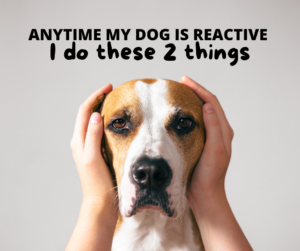
ANYTIME MY DOG IS REACTIVE…I DO THESE 2 THINGS

º

Having a reactive dog is HARD. You have to be careful of who is walking the dog, where the dog is, what is going on around the dog…and much much more.

Before we even get into how STRESSED OUT the dog is…the toll it takes on human families is high. Not to mention innocent bystanders who have to protect themselves because they don’t understand your dog.

Here are 2 ways we START to address reactivity. Please note: in our program we GET RID of reactivity, we build confident dogs and even get them OFF-LEASH running around free.

These 2 items are just to get by until you can see a trainer.

  1. Create space . The farther away your dog is from the “trigger” the less intense the explosion will be. Cross the street, turn around, walk away.
  2. Practice mindfulness with YOUR body. Watch your energy. If you tense up your dog will too. Relax…calm hands equals calm dog. And last but not least…HANDS OFF your dog. You get what you pet…if you “console” a reactive dog you will get more of it.

Please contact us here if you need more personalized help. Remember…our training goes beyond these tips and actually helps build your dog up! See you soon!

More Tips

Check out our other posts

Does Training Count as Mental Exercise for Dogs?

Is your dog still full of energy even after a long walk?

The problem may not be a lack of physical exercise—it could be a lack of mental stimulation. In this article, you’ll discover why training counts as mental exercise, how it can help reduce common behavior problems like jumping, barking, and destructive chewing, and why just 10 minutes of focused training can be more effective than an hour of physical activity.

Learn simple ways to challenge your dog’s mind through training games, food puzzles, scent work, and everyday enrichment activities that create a calmer, happier, and better-behaved companion.

Read More »

The Dog Training Secret Most Owners Overlook

You walk your dog, play fetch, and make sure they get plenty of exercise—so why are they still barking, pulling on the leash, jumping on guests, or acting restless at home?

The answer may be simpler than you think. Many behavior problems aren’t caused by a lack of physical exercise but by a lack of mental stimulation. In this article, you’ll discover why mental exercise is essential for your dog’s well-being, how just a few minutes of brain work can reduce unwanted behaviors, and simple ways to create a calmer, more focused, and better-behaved dog.

Read More »

Your Dog Has 5 Bosses—and That’s the Problem

Think your dog is stubborn? Think again.

Many behavior problems—from ignoring commands and pulling on the leash to jumping on guests and begging at the table—aren’t caused by a lack of training. They’re caused by confusion. When family members use different commands, enforce different rules, or reward different behaviors, dogs are left guessing what’s expected of them.

In this article, you’ll discover how inconsistency creates hesitation, why your dog may listen to some people but not others, and the simple changes that can transform confusion into confidence.

Read More »

The Hidden Psychology Behind Dog Regression After Travel

Did your dog suddenly stop listening after boarding or vacation?

You’re not alone. Many dogs regress after travel because changes in routine reset their expectations and create confusion.

In this blog, you’ll learn the real psychological reason dogs test boundaries after vacations, how accidental habits reinforce bad behavior, and the simple “vacation reset” smart dog owners use to get their dogs listening again fast.

Read More »