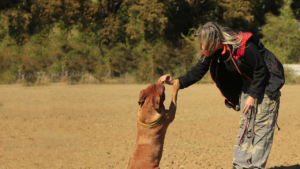
If you’ve ever watched me work a reactive dog and thought, “Why didn’t she correct that right away?” — you’re not alone. It’s one of the most common questions I get.
From the outside, it can look like a missed opportunity. The dog reacts. The behavior is obvious. The moment feels big. So why not step in immediately?
Because real training isn’t about reacting to behavior — it’s about shaping it. And that requires timing, emotional awareness, and strategy.
A correction given at the wrong moment doesn’t teach clarity. It can create confusion, increase stress, and actually strengthen the reactive pattern. My job isn’t to stop a scene. My job is to change the behavior long-term.
There’s a major difference between training and theatrics. One looks dramatic. The other builds results.
In this blog, I’m breaking down why timing matters, what I’m actually watching for, and how protecting the moment protects your progress.
Because I’m Protecting Your Progress — Not Just Stopping a Moment
Correcting immediately might feel satisfying.
Your dog lunges. Barks. Explodes.
And every instinct says, “Stop it right now.”
I get it. You want the behavior shut down. You want relief. You want to feel back in control.
But here’s the truth most people don’t realize:
If your dog is already over threshold — meaning emotionally flooded, adrenaline up, thinking brain off — a correction in that moment doesn’t teach. It interrupts. And interruption is not the same thing as learning.
When a dog is over threshold, a poorly timed correction can:
- Create confusion because they can’t clearly connect cause and effect
- Increase anxiety, which strengthens the emotional response behind the reactivity
- Suppress the behavior temporarily, only for it to come back stronger next time
And that’s how owners end up stuck in a cycle. The dog reacts. You correct harder. The dog reacts bigger. Now the walks feel worse than before.
That might win the moment.
But it loses the war.
My job isn’t to put on a show or prove control in front of you. My job is to create lasting behavioral change. And sometimes that means I choose not to correct immediately because I’m evaluating whether the dog is actually in a state to learn.
If they aren’t ready to process information, the correction won’t build clarity — it will build pressure.
And pressure without understanding creates instability.
When I pause, adjust distance, redirect, or reset before correcting, I’m not ignoring the behavior. I’m setting up the next repetition to be successful. I’m making sure the dog can connect the feedback to the decision they made.
That’s how patterns change.
Because let’s be honest — you don’t want to pay twice to fix the same problem. You don’t want months of “sort of better.” You don’t want a dog that behaves when pressure is high but falls apart when it’s not.
You want reliability.
And reliability doesn’t come from dramatic reactions.
It comes from strategic timing.
I’m not trying to win a moment.
I’m protecting your progress.
You don’t want to pay twice to fix the same problem. You want reliability — not temporary control.
And here’s something important: not all stress shows up as barking and lunging. Sometimes it shows up as shutting down. Freezing. Avoiding. If your dog has ever “checked out” during training instead of reacting, that’s a different emotional state that requires a different approach entirely.
I break that down here: https://bethebossdogtraining.com/why-does-my-dog-shut-down-or-freeze-during-training-instead-of-engaging-with-me/
Understanding emotional state is everything. Timing depends on it.
Because Timing Determines Whether Your Dog Learns — Or Just Gets Startled
Here’s something most dog owners don’t realize:
Dogs don’t learn from corrections.
They learn from clear, well-timed information.
There’s a massive difference between a correction that teaches and a correction that simply startles.
If I correct too late, your dog won’t connect it to the trigger. In their mind, the consequence won’t be tied to the decision to lunge, bark, or stiffen. It will just feel random. And random feedback creates confusion — not clarity.
If I correct too early, before the dog has actually committed to the behavior, they won’t understand what choice they’re being corrected for. That creates hesitation, uncertainty, and sometimes even anxiety because the rules feel unpredictable.
And if I correct while your dog is emotionally flooded — adrenaline high, thinking brain offline — learning shuts down completely. When a dog is in full reaction mode, they’re in survival mode. You can’t reason with survival. You can only manage it.
That’s why timing is everything.
There’s a tiny window — sometimes just seconds — where the dog is aware of the trigger, considering a decision, and still capable of processing information. That’s the teachable moment. That’s where precision lives.
When I wait, adjust positioning, control distance, or allow a micro-second of awareness before intervening, I’m not hesitating. I’m lining up that learning window.
Because here’s the truth:
A mistimed correction can slow progress down.
A precisely timed one accelerates it.
This is where training separates from theatrics. Theatrics react fast. Training reacts correctly.
And I know what you’re thinking — you don’t want a drawn-out process. You don’t want months of trial and error. You don’t want to keep revisiting the same issue.
You want it fixed correctly the first time.
That only happens when timing is intentional.
Quick reactions might make you feel proactive. But strategic timing creates understanding. And understanding is what makes behavior stick — even when I’m not standing next to you.
Because at the end of the day, I’m not training your dog to respond to me.
I’m training your dog to make better decisions for you.
Because I’m Watching What You Don’t See
When your dog barks or lunges, that’s the loud part.
That’s the obvious part.
But by the time you see the explosion… the decision was already made seconds earlier.
While you’re seeing the reaction, I’m watching everything that led up to it.
I’m assessing stress signals — the subtle ear shift, the mouth closing, the weight shift forward, the hard stare. Those micro-movements tell me when your dog is escalating before they ever make a sound.
I’m evaluating threshold levels — how close is too close? Was this reaction about distance, duration, or intensity? Did we stack too many triggers too quickly?
I’m scanning environmental triggers — Is that dog staring? Is there tension on the leash? Is your dog trapped with no exit space? Did a sound spike adrenaline?
I’m watching your leash handling — Did tension increase before the reaction? Did your body stiffen? Did you unknowingly signal concern?
And I’m already thinking three steps ahead about future setup strategy — Do we need more distance next rep? A better angle? A slower approach? A different reward structure?
All of that happens before I ever consider correcting.
Because correction without assessment is theatrics.
It looks decisive. It looks strong. It might even feel satisfying in the moment.
But leadership isn’t reactive. Leadership is calculated.
If I correct without understanding the “why” behind the behavior, I’m guessing. And guessing with behavior can create fallout — increased anxiety, redirected frustration, or suppressed warning signs.
That’s not training. That’s gambling.
When I pause, reposition, or choose not to correct immediately, it’s because I’m gathering information. I’m making sure the next move actually builds clarity instead of pressure.
Anyone can react to barking.
Not everyone can read the layers underneath it.
And if you’re investing in professional training, you don’t want someone guessing. You don’t want someone reacting emotionally. You don’t want someone performing.
You want someone who actually knows what they’re doing with your dog.
Real skill in reactivity work isn’t loud.
It’s observant.
It’s strategic.
It’s intentional.
I’m not just watching behavior.
I’m reading your dog like a blueprint — so we can change the pattern at the root, not just silence the symptom.
Correction without assessment is theatrics.
Assessment before action is leadership.
You want someone who actually knows what they’re doing with your dog — not someone guessing in real time.
And if you’re navigating reactivity right now, you’re not the only one. Seeing other owners work through the same struggles can be incredibly helpful.
If you’re local to Utah County and want real conversations and support, you can join our free community here:
https://www.facebook.com/groups/dogsunleashedutahcounty
Because My Job Is to Change the Pattern — Not Impress the Room
Quick corrections look impressive.
They’re sharp. Immediate. Decisive.
They make it seem like something big just happened.
But dramatic doesn’t equal effective.
In fact, some of the most powerful training moments don’t look exciting at all. They look calm. Controlled. Almost… boring.
And that’s the point.
Real behavior change happens in the quiet repetitions. The subtle shifts. The moments where your dog notices a trigger, processes it, and chooses differently. That kind of change doesn’t require theatrics — it requires clarity and consistency.
Anyone can shut down a behavior in the moment.
Not everyone can rewire the pattern underneath it.
If my goal was to impress the room, I’d react big. I’d step in fast. I’d create a visible “correction moment” that feels satisfying to watch.
But I’m not here for applause.
I’m here for outcomes.
Because here’s what really matters: What happens when you’re alone on a walk? What happens when I’m not standing next to you? What happens on a random Tuesday evening when another dog rounds the corner unexpectedly?
That’s the real test.
If training only works when pressure is high or when I’m present, it’s not reliable. And reliability is what gives you freedom — freedom to walk peacefully, to relax, to stop scanning every block in anxiety.
Sustainable change often looks slower at first. It looks methodical. It looks intentional. But it builds understanding instead of fear, clarity instead of suppression.
And that’s what lasts.
I know social media has made dog training look flashy. Quick fixes. Big reactions. Before-and-after moments packed into 10 seconds.
But you don’t live in a highlight reel.
You live in daily routines.
You care more about peaceful walks, calm guests at the door, and confidence in public than what a single training clip looks like.
You don’t need a performance.
You need a dog you can actually live with.
And that’s exactly what I’m here to build.
Conclusion
If you take one thing away from this, let it be this: hesitation is not weakness — it’s strategy.
When I don’t correct immediately, it’s not because I missed it. It’s not because I’m unsure. And it’s definitely not because I’m ignoring the behavior. It’s because I’m protecting the learning window, the emotional state of your dog, and the long-term outcome you hired me for.
Real training isn’t about stopping noise. It’s about changing patterns. It’s about timing, assessment, and intentional leadership. Sometimes that looks quiet. Sometimes it looks uneventful. But underneath that calm approach is precision.
You don’t just want a dog that stops reacting in front of me.
You want a dog that makes better decisions with you.
And that only happens when we prioritize clarity over theatrics — and progress over performance.
That’s how we build reliability.
If you’re tired of guessing, reacting, and hoping things improve on their own — let’s build a clear plan.
Reactivity doesn’t fix itself. And it doesn’t improve with random corrections or YouTube tips. It improves with strategy, timing, and leadership.
If you’re ready to stop managing chaos and start creating clarity, reach out here:
👉 https://bethebossdogtraining.com/contact-us/
Let’s fix it correctly the first time.