FOR THE PEOPLE WITH GOOD DOGS THAT USED TO BE BAD

º

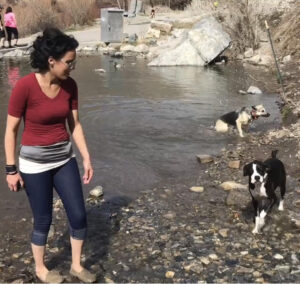
This weekend we took our dogs up Provo Canyon to Bridal Veil Falls…and it was busy! So many people and so many other dogs. 

My boxer mix has a history of lunging and being reactive to other dogs. 

If I don’t correct him in the moment he is thinking about lunging, it can turn very messy very quickly.

And especially my experiences with my boxer up this canyon have always been negative. I started training him once winter started, and we have not traversed this section of the city since then.  To be respectful of other people I had him on his prong collar and a short 2′ leash. However, the second we started down the path I was anxious, nervous, expecting the worst, and very tense.

Of course my dog picked up on my energy as dogs will. He wasn’t paying attention to me, he had high energy, and my corrections on the prong were not as effective. When I train, I tell all my clients to relax and forget that their dog was ever a bad dog, and I wasn’t even taking my own advice.

Finally, my husband noticing something was wrong, stopped me and said “Okay, this isn’t working.” He turned to me, “These dogs are off-leash trained and they do great. I’m going to let them off their leash and we are going to continue just like you’ve been doing for the last 2 months. And everything is going to be fine.” Dogs were let off the leash and on we continued.

With that small reminder my shoulders relaxed, my jaw muscles loosened, my arms started to swing more naturally, and the sound and enjoyment came back into the day. Immediately the dogs were responsive, attentive to me and more obedient. We had a great walk, they went swimming and they were the best behaved dogs up there. My husband even asked me after “Did I see all the people staring at me and the dogs because they were so obedient and well-behaved?” Coming when called, heeling, running and sniffing and then coming back to heeling when we moved on. 

I felt a little sheepish that I wasn’t able to take my own advice in this instance. My memories and experiences of what it used to be like up this canyon crowded out the 2 months of incredible work and trust I’ve had with my dogs. 

For people like me who had “bad” dogs that are now good dogs it can be hard to forget. We get around places or people where our memories tell us this was always a negative experience and we prepare for that negative experience….thereby causing the negative experience.

To all these people I say…chin up! It’s a new day, and a new dog!

More Tips

Check out our other posts

Does Training Count as Mental Exercise for Dogs?

Is your dog still full of energy even after a long walk?

The problem may not be a lack of physical exercise—it could be a lack of mental stimulation. In this article, you’ll discover why training counts as mental exercise, how it can help reduce common behavior problems like jumping, barking, and destructive chewing, and why just 10 minutes of focused training can be more effective than an hour of physical activity.

Learn simple ways to challenge your dog’s mind through training games, food puzzles, scent work, and everyday enrichment activities that create a calmer, happier, and better-behaved companion.

Read More »

The Dog Training Secret Most Owners Overlook

You walk your dog, play fetch, and make sure they get plenty of exercise—so why are they still barking, pulling on the leash, jumping on guests, or acting restless at home?

The answer may be simpler than you think. Many behavior problems aren’t caused by a lack of physical exercise but by a lack of mental stimulation. In this article, you’ll discover why mental exercise is essential for your dog’s well-being, how just a few minutes of brain work can reduce unwanted behaviors, and simple ways to create a calmer, more focused, and better-behaved dog.

Read More »

Your Dog Has 5 Bosses—and That’s the Problem

Think your dog is stubborn? Think again.

Many behavior problems—from ignoring commands and pulling on the leash to jumping on guests and begging at the table—aren’t caused by a lack of training. They’re caused by confusion. When family members use different commands, enforce different rules, or reward different behaviors, dogs are left guessing what’s expected of them.

In this article, you’ll discover how inconsistency creates hesitation, why your dog may listen to some people but not others, and the simple changes that can transform confusion into confidence.

Read More »

The Hidden Psychology Behind Dog Regression After Travel

Did your dog suddenly stop listening after boarding or vacation?

You’re not alone. Many dogs regress after travel because changes in routine reset their expectations and create confusion.

In this blog, you’ll learn the real psychological reason dogs test boundaries after vacations, how accidental habits reinforce bad behavior, and the simple “vacation reset” smart dog owners use to get their dogs listening again fast.

Read More »