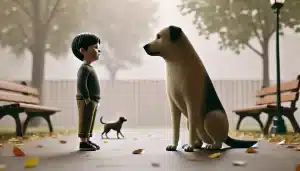
Picture this: A sunny afternoon at the local park. Moms and dads lounge on benches, chatting about life while kids dart around like pinballs, laughing and chasing each other. In the middle of this picturesque scene is a well-behaved dog—let’s call him Max. Max is with his owner, casually minding his own business, sniffing the grass, happy to be outside. And then, the inevitable happens: a small child, sticky from whatever snack they’ve been inhaling, rushes up to Max with all the excitement of a miniature tornado. They reach out with tiny hands to pet his fur, their eyes sparkling with delight.
What happens next is a reality that many dog owners are familiar with but not everyone talks about: Max backs away, his ears flatten, and his tail tucks between his legs. He doesn’t snap or growl—he just clearly wants nothing to do with this small, loud, and unpredictable human. The parent quickly pulls the child back, and the child looks confused, maybe even a little hurt. Why doesn’t Max want to be their friend?
Here’s the truth: Some dogs don’t like kids. And you know what? That’s okay.

The Myth of the “Kid-Friendly” Dog
There’s this unspoken assumption that all dogs are supposed to love kids. We’ve been fed images of Golden Retrievers happily frolicking with children in TV commercials and family movies for so long that it feels like every dog should instinctively want to be a kid’s best friend. The reality, however, is much more nuanced.
Not every dog is cut out for the chaotic energy of a child. Just like people, dogs have their own personalities, preferences, and limits. Expecting every dog to love being poked, prodded, hugged, and chased by a kid is like expecting every person to enjoy being stuck in a room with a toddler who’s just discovered the joy of banging pots and pans together.

Why Dogs Might Not Like Kids
So, why don’t some dogs like kids? There are a few key reasons:
- Unpredictable Movements: Kids move differently from adults. They run, jump, stumble, and fall in ways that can make a dog feel uneasy. For a dog that’s naturally cautious or reactive, this can be a bit much to handle.
- Loud Noises: Kids scream. They yell. They laugh loudly. Dogs, especially ones with sensitive ears, can find this overwhelming. A sudden high-pitched squeal can trigger a dog’s fight-or-flight response.
- Invasion of Personal Space: Many kids haven’t learned the concept of personal space yet, and dogs, like some people, value their bubble. A child rushing toward a dog, hands outstretched, might be well-meaning but can come off as an invasion to the dog.
- Past Experiences: Dogs are shaped by their experiences. A dog that’s had a bad experience with a child—whether it was pulled too hard by its tail or had toys thrown at it—might understandably be wary of all children moving forward.
- Natural Temperament: Some dogs are just naturally shy, anxious, or reserved. That’s their personality, and it’s perfectly normal. Just like some people are introverts who prefer a quiet evening at home, some dogs would rather relax in a calm environment than deal with the unpredictability of a child’s energy.

My Own “Max” Story
I remember the first time I discovered that not all dogs are fans of kids. It was a lesson learned the hard way.
When I was a kid, I had a neighbor named Mrs. Palmer who had a beautiful Collie named Daisy. Daisy looked like she’d walked straight out of Lassie—all flowing fur and soulful eyes. Naturally, I assumed Daisy would want to be my best friend. So, one summer afternoon, I wandered over to Mrs. Palmer’s yard, excited to pet Daisy. I must have been about eight years old at the time, a ball of energy and curiosity.
Daisy, however, did not share my enthusiasm. I approached her with outstretched arms, but before I could get close, she darted to the far side of the yard, eyeing me cautiously. I was baffled. Hadn’t she seen the same TV shows I had? Weren’t we supposed to be instant friends?
I tried again, this time more slowly, crouching down and calling her name in the sweetest voice I could muster. Daisy remained unmoved, glued to her spot, tail low, clearly not interested in whatever friendship I was offering. Mrs. Palmer, seeing my confusion, came over and gently explained that Daisy was a little shy around kids. “She’s not a bad dog,” she said, “but she just doesn’t know what to make of all that energy.”
At first, I was hurt. How could Daisy not want to be my friend? But then, as I spent more time around her, I realized it wasn’t personal. Daisy was great with adults—calm, friendly, and affectionate—but kids? Not so much. And that was okay. She wasn’t a bad dog. She was just Daisy.

Accepting a Dog’s Boundaries
The important lesson here is that we need to respect dogs for who they are, not who we want them to be. Just because a dog doesn’t want to play with kids doesn’t make them a bad dog. They have boundaries, and those boundaries deserve to be respected—just like you wouldn’t force a shy child to entertain strangers.
As parents or dog owners, it’s crucial to teach children to recognize and respect a dog’s signals. If a dog backs away, avoids eye contact, or seems tense, that’s the dog’s way of saying, “I need space.” And that’s a lesson that extends beyond just interacting with dogs—it’s about respecting the boundaries of others, human or otherwise.

How to Help Kids and Dogs Coexist Peacefully
While it’s perfectly fine that some dogs don’t like kids, there are ways to ensure that your child and your dog can peacefully coexist:
- Teach Respect Early: Educate your kids from a young age about how to approach dogs calmly and respectfully. Show them how to read a dog’s body language—ears, tail, and posture can tell you a lot.
- Create Safe Spaces: Make sure your dog has a safe, quiet space where they can retreat if they’re feeling overwhelmed. Teach your kids that this space is off-limits and a “no-interruption” zone for the dog.
- Supervise Interactions: Always supervise interactions between dogs and young children. Even the most well-behaved dog can get startled or overwhelmed by a child’s sudden movements or noises.
- Positive Reinforcement: Reward your dog when they behave calmly around kids. Over time, they may become more comfortable with the presence of children, even if they’re never fully enthusiastic.

Why It’s Okay for Dogs Not to Like Kids
Here’s the thing: It’s completely okay for a dog to not like kids. Just like people, dogs have their own preferences, personalities, and experiences that shape how they react to the world. Expecting every dog to love kids is like expecting every person to love loud parties—it’s just not realistic. And that’s fine.
In fact, by acknowledging that some dogs prefer a quieter, less chaotic environment, we’re respecting their individuality. They don’t need to fit the stereotype of the perfect family dog to be wonderful, loving companions.
So the next time you’re at the park and see a dog like Max avoiding a group of kids, don’t judge. Some dogs just aren’t into the toddler tornado, and that’s perfectly okay. Max is still a good dog—he just knows what he likes, and that’s something we can all appreciate.
In the end, it’s not about forcing a bond between dogs and kids—it’s about respecting each other’s space, energy, and preferences. And who knows? Maybe one day, Max will find his perfect kid match. Until then, let’s let dogs be dogs—quirks, preferences, and all.