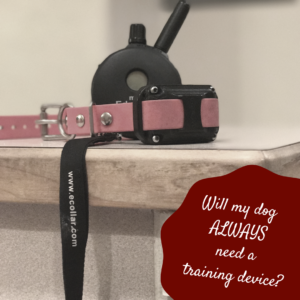
WILL MY DOG ALWAYS NEED THEIR TRAINING DEVICE?

º

This is a GREAT question. It’s a question I get at every evaluation.
The answer is a combination of personal choice + the dog’s behavior. Let’s start with personal choice.
(Please be aware, we are starting from the assumption that your dog is already using a training device, and using it correctly)

  1. Personal Choice
    The training device should only be active when the dog makes a wrong choice. A wrong choice looks like: jumping on people, barking, pulling on the walk, whining in the crate, etc).
    Therefore, there is no harm coming to the dog by wearing the device if the dog is behaving properly. It is just another item on the dog.
    If the dog is behaving properly in a calm environment, and you have the dog’s complete attention even under outside distractions, then by all means feel free to take the device off.
    I, personally, see the training device as a seatbelt. I know that I haven’t gotten in an accident the last 100 trips to the grocery store, but that doesn’t mean THIS time it won’t happen. I want my seatbelt on, because sometimes…it’s not your fault that accidents happen.
    My dogs always wear their training device because sometimes another dog comes running straight at us (as seen here) , and I need to KNOW that I have my dogs under control.
    So…no, you do not always have to have a training device on your dog. Though it might be wise to still have it handy because you can’t control what OTHER people do.
  2. The Dog’s Behavior
    Second (and most important) part of the equation…your dog!
    Some dogs might need a training device for the rest of their lives. It’s more a matter of their unique temperament than of behavior.
    For example: I tend to be anxious and stressed. I KNOW that I need to do yoga for at least 15 minutes a day in order to handle the stresses of life. Am I going to try and wean myself off yoga? I could…possibly…
    But why wean myself off yoga when it’s something that’s simple, easy, and keeps me centered and balanced?
    Same concept for the training device. My German shepherd has anxiety, it’s part of who she is. Why would I try and remove the device that is keeping her mentally healthy and happy?

    In conclusion…will your dog always NEED their training device? Maybe…maybe not. Your dog is unique and special and THEY will tell you what they need.
    If it comes down to personal choice, then do what is best for you and your family. After all, we all love our dogs and want what’s best!
More Tips

Check out our other posts

If Grooming Your Dog Feels Like a Wrestle Match, Read This

If grooming your dog feels like a fight every single time, you’re not alone—and it’s not actually about grooming.

Most dogs resist because they’ve never been taught how to stay still, accept handling, or cooperate through the process. The result? Wiggling, pulling away, scratched hands, wasted time, and expensive groomer visits that don’t fix the problem.

The good news is this: you don’t need better tools or more patience—you need a better approach. When you teach your dog calm handling and stillness, everything changes. Grooming becomes faster, easier, and far less stressful for you. In this blog, you’ll learn how to stop the struggle, cut grooming time in half, and finally get through it without the chaos.

Read More »

Leash Pulling Isn’t the Problem—Your Dog Is Making the Decisions

Leash pulling, ignoring commands, and constant distraction aren’t just bad habits—they’re signs your dog is making the decisions.

If your dog only listens when it benefits them, walks feel exhausting, or you’re getting embarrassed in public, the issue isn’t more commands—it’s clarity in leadership.

In this blog, you’ll learn why dogs take control on walks, how that affects their behavior in real-world situations, and what it actually takes to become the one your dog chooses to follow. Because once that shifts, everything else starts to fall into place.

Read More »

The Timing Mistake That’s Ruining Your Dog’s Training

Struggling with a dog that only listens sometimes?

The issue might not be your commands—it’s your timing. In this guide, we break down how rewarding too early creates confusion, slows progress, and leads to inconsistent behavior.

Learn how one simple shift can make training clearer, faster, and way more effective for both you and your dog.

Read More »

The Truth About ‘Random’ Aggression (And Why It’s Ruining Your Life)

Most dog owners think their dog’s aggression comes “out of nowhere”—but what if it’s actually a pattern you’ve been missing the entire time?

From stressful walks to uncomfortable moments with guests, your dog’s behavior isn’t just frustrating… it’s affecting your daily life more than you realize. The good news? It’s predictable—and that means it’s fixable. In this blog, you’ll learn how to spot the hidden triggers, understand the warning signs, and recognize the 30-second pattern that happens before every reaction.

Once you see it, you can step in earlier, prevent the behavior, and finally start enjoying life with your dog again.

Read More »