
Most people, when they hear the word “ecollar”, do not have positive images come to mind. At best, you think of a training device that uses compulsion…and at worst, you imagine a torture device.
I’m here to share my story about my experience with an ecollar.
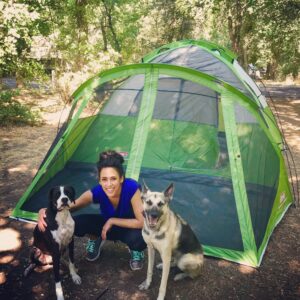
This last weekend my husband and I took our two dogs for an overnight camping trip up a local canyon. It was our very first time camping as a married couple (only took us 10 years), and our dog’s first camping trip ever.
One of my dogs is part hunting dog (Carbon), and the other is a high-drive german shepherd (K’ehleyr)…so I knew it was important that I be able to communicate with my dogs in the woods. With ecollars charged and ready to go, we arrived at our camp-site.
The ecollar was awesome at setting boundaries for my dogs…how far away they could go, and where the edges of our campsite were. So far so good!
The life-saving event occurred while I was distracted, preparing dinner so when my husband got back with the firewood we could just start cooking.
Out of the corner of my eye I saw Carbon’s head go up, and he started staring intently at something in the brush about 10 feet away from him. All of a sudden, a rabbit LEAPED out of the grass and started running.
That was all it took for Carbon. He was OFF!
At first I started laughing, because it was so cute and funny to see Carbon trying to catch something that (if you know him) he really had no hope of catching. I wasn’t really worried about the rabbit being eaten, and it was fun seeing my dog running in the woods.
Suddenly, it wasn’t fun anymore. I realized Carbon was running full-speed straight for the busy roadway that leads into the camping area. Campers, RVs, and vehicles go whizzing down this road at upwards of 40 mph. I knew there really wouldn’t be much hope for Carbon if he got hit.
There was NO WAY he was going to respond to my voice when he was this charged up. A moment of panic…how the HECK was I going to stop him from getting hit?
I grabbed the ecollar remote and punched the button. “Carbon, come!” I yelled. He stopped, looked at me…then back at the running bunny…then back at me. “Carbon, come!” I said again as I tapped the button.
He came trotting back to me, looking a little sheepish that he wasn’t able to catch the bunny. I rubbed him behind the ears, and told him what a good boy he was. He licked my hand, then immediately turned his attention to begging for the yummy hot dogs on the table.
So, in conclusion…I always knew that ecollars could save a dog’s life. And it has always kept Carbon safe from wandering into a busy parking lot, or jumping on a small child.
However, it is a POWERFUL thing to have the means to save your dog’s life. I am so grateful that I trained my dog on ecollars, and that I have this GREAT tool at my disposal.
If you have any genuine questions about ecollars please feel free to email me.
Take a look at our camping video below, and have a great rest of your day!
-Bethany