
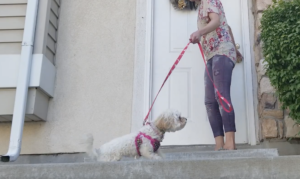
TRUST ME, YOUR DOG IS NOT “PROTECTING” YOU

º

Does your dog bark at strangers in the house? How about when you are outside and someone approaches? Does your dog run up and bark at them? Don’t be fooled. Your dog is not “protecting” you.
I encounter this a lot with potential clients. After all, the behavior certainly looks like they are protecting you. But I promise, they are not. There are a variety of factors for why your dog may be displaying this behavior. I am going to talk about 2 of them.

  1. There is a lack of believable structure in the home
    Your dog does not have a leader in the home. Therefore, your dog does not believe that anyone in the home will protect them. This results in an insecure and anxious dog when exposed to new people and situations.
    An insecure dog will bark (and sometimes bite) the perceived threat. This makes the threat go away so they can feel comfortable again.
  2. Your dog sees you as a possession
    Your dog feels they own you. After all, why wouldn’t you want to guard something that gives you wonderful food, soft beds, great toys, and all the love and attention in the world? You are their goose that lays golden eggs!

Much like a dog will growl or bite when you try and take a bone away…you are the bone. Anyone coming up to greet you is trespassing on their property. Your dog will bark, growl, or bite when they are faced with the prospect of losing their prized possession.
So next time your dog barks at someone coming near you, just remember that your dog is not protecting you. Your dog is missing a leader in their life. Be that leader for them..they deserve it.

More Tips

Check out our other posts

Does Training Count as Mental Exercise for Dogs?

Is your dog still full of energy even after a long walk?

The problem may not be a lack of physical exercise—it could be a lack of mental stimulation. In this article, you’ll discover why training counts as mental exercise, how it can help reduce common behavior problems like jumping, barking, and destructive chewing, and why just 10 minutes of focused training can be more effective than an hour of physical activity.

Learn simple ways to challenge your dog’s mind through training games, food puzzles, scent work, and everyday enrichment activities that create a calmer, happier, and better-behaved companion.

Read More »

The Dog Training Secret Most Owners Overlook

You walk your dog, play fetch, and make sure they get plenty of exercise—so why are they still barking, pulling on the leash, jumping on guests, or acting restless at home?

The answer may be simpler than you think. Many behavior problems aren’t caused by a lack of physical exercise but by a lack of mental stimulation. In this article, you’ll discover why mental exercise is essential for your dog’s well-being, how just a few minutes of brain work can reduce unwanted behaviors, and simple ways to create a calmer, more focused, and better-behaved dog.

Read More »

Your Dog Has 5 Bosses—and That’s the Problem

Think your dog is stubborn? Think again.

Many behavior problems—from ignoring commands and pulling on the leash to jumping on guests and begging at the table—aren’t caused by a lack of training. They’re caused by confusion. When family members use different commands, enforce different rules, or reward different behaviors, dogs are left guessing what’s expected of them.

In this article, you’ll discover how inconsistency creates hesitation, why your dog may listen to some people but not others, and the simple changes that can transform confusion into confidence.

Read More »

The Hidden Psychology Behind Dog Regression After Travel

Did your dog suddenly stop listening after boarding or vacation?

You’re not alone. Many dogs regress after travel because changes in routine reset their expectations and create confusion.

In this blog, you’ll learn the real psychological reason dogs test boundaries after vacations, how accidental habits reinforce bad behavior, and the simple “vacation reset” smart dog owners use to get their dogs listening again fast.

Read More »