
Okay, okay. The title of this article sounds really harsh. My goal for the title was to wake people up a little.
Did you know that for a lot of my clients I am NOT their first trainer?
That almost all of them have already been through a training class, or spent weeks watching YouTube videos trying to stop a bad behavior? And I can tell you exactly why they are failing.
Teaching a dog to sit, down, stay, and come are just TRICKS. That’s right. Holding a treat in your hand and asking a dog to do an action is a trick. You might as well be standing in a 3-ring circus entertaining paying customers.
Don’t get me wrong. I’m a huge fan of teaching a dog to sit, down, come, and stay. In fact, these are essential for them surviving in your human world.
But guess what? I don’t really care if my dog sits down when someone knocks on the door. I just don’t want them to bark and run to the door. My clients don’t care if their dog sits when they see another dog on a walk, they just don’t want their dog to pull on the leash.
It’s time we stop teaching tricks and start teaching MANNERS. Stop your dog from running out an open door, stop them from barking, stop them from pulling on the leash, stop them from jumping, stop them from chasing the kids or getting into the trash…and I can promise you that you won’t give a darn if your dog doesn’t sit when the doorbell rings.
So how do you teach a dog manners? That, my friends, is based on your relationship with your dog. What does that mean, you ask?
Let me explain.
What does your dog do when you give a command your dog doesn’t want to obey? What happens when you tell your dog to stop jumping and they don’t want to? THAT is your relationship with your dog. Your dog needs to value your opinion over their own.
I hear people tell me all the time that their dog is super well-behaved in the house and the only issue they have is outside the home, like barking at other dogs. And my response is “Well, OF COURSE they are well-behaved in the house”. If I was a teenager and had unlimited freedom, keys to the car, my own credit card and no rules…believe me, I would tell my parents how much I loved them ALL the time. Of course I would.
But if my parents set up a curfew, made me finish my homework, and do chores before I went out for the evening…how would I react? I would probably throw a fit. If you set up rules and expectations for your dog that they HAVE to obey, how do they react? How do they react when you correct them? THAT is your relationship with your dog.
Most people are not aware of the nature of their relationship with their dog. They are not aware that their dog just sees them as a treat dispenser. And so they struggle.
Stop teaching your dog tricks. Start correcting them for naughty behavior, start crating them, and start living a lifestyle conducive to creating a happy, healthy, calm dog.
Thanks for reading, and if you would like some free tips please contact us here!
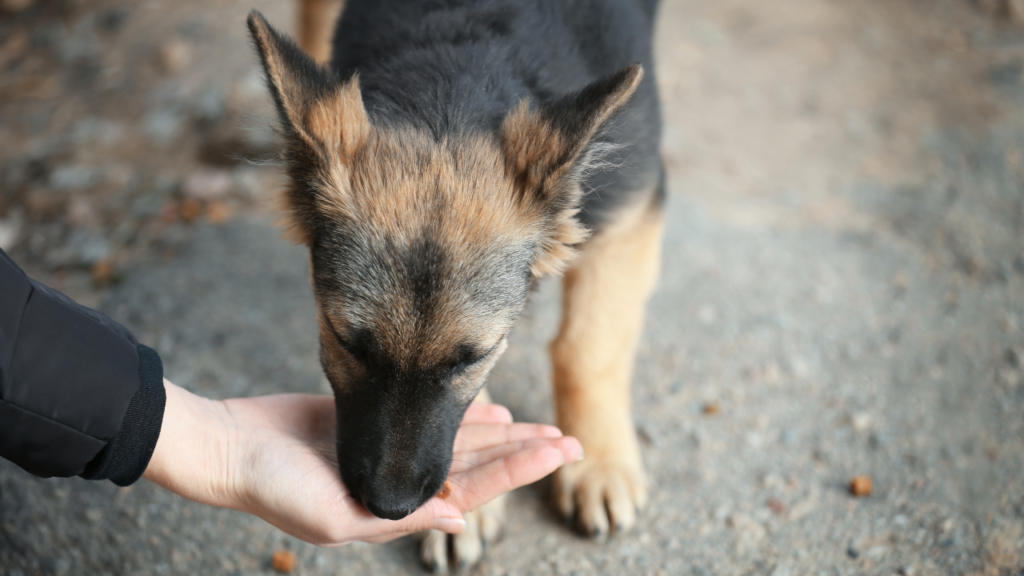
The Hidden Downside of Hand-Feeding Your Dog
Hand-feeding can be a great training tool—but what happens when your dog starts depending on it?
Learn how too much hand-feeding can create unwanted habits, the difference between rewarding and bribing, and how to raise a confident dog who listens even when there’s no treat in your hand.

How Too Much Visual Access Fuels Dog Reactivity
Is your dog constantly barking at people, delivery drivers, dogs, or squirrels outside?
Too much visual access could be fueling their reactivity.
Learn how windows, open floor plans, and neighborhood “watch duty” can encourage barking—and discover simple changes that can help your dog settle down and give you a quieter, more peaceful home.

Why Clear Communication Changes Everything
Think your dog is stubborn, ignoring you, or deliberately testing your patience?
The truth might be simpler: your dog is constantly reading your body language, tone, timing, consistency, and follow-through. When those signals don’t match what you’re saying, your dog can become confused about what you actually want.
Discover why your dog may listen perfectly to a trainer but struggle with you, why repeating commands can make things worse, and how clearer communication can lead to less frustration, better behavior, and a stronger relationship with your dog.
Stop Negotiating With Your Dog: Make Your First “No” Count
Your dog isn’t ignoring you by accident—they may have learned that if they wait long enough, you’ll give in.
From leash pulling and jumping to selective listening and treat bribery, inconsistent boundaries can accidentally reinforce the behaviors driving you crazy.
Learn how calm, consistent follow-through can help you stop repeating yourself, communicate more clearly, and build a dog that actually listens the first time.