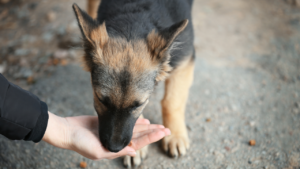
Hand-feeding can be a valuable training tool, but relying on it too heavily may encourage dependency instead of independence. The goal is to use food strategically so your dog learns to make good choices even when you’re not holding a treat.
Hand-feeding your dog sounds like a great idea. It can help build engagement, make training more rewarding, and even strengthen your relationship. But there’s a catch: if you’re constantly handing your dog every bite of food, you may accidentally teach them that they need you for everything.
Instead of creating confidence and independence, excessive hand-feeding can sometimes create a dog who waits for you to provide direction, entertainment, rewards, and reassurance. You might notice your dog becoming picky about eating from a bowl, constantly following you around, or only responding to commands when they know you have food.
Does that mean you should never hand-feed your dog? Absolutely not. Hand-feeding can be a useful training tool when there’s a purpose behind it. The key is knowing when it’s helping your training—and when it’s becoming a crutch.
Let’s look at how to build a dog who listens to you without constantly needing you.
Are You Accidentally Training Your Dog to Need You?
Hand-feeding can be a fantastic training tool. The problem starts when it goes from being a tool to becoming the only way your dog knows how to eat, engage, or cooperate with you.
Think about what your dog is learning every time food comes directly from your hand. If every meal is delivered one piece at a time, your dog may begin to associate eating with your constant involvement. Instead of simply eating when food is available, they learn to look to you first.
And that can become inconvenient FAST.
You put breakfast in the bowl…and your dog stares at you.
You walk away…and they follow you.
You come back, pick up a few pieces of kibble, and suddenly they’re interested.
Without realizing it, you may have taught your dog, “If I wait long enough, my human will make eating more interesting.”
That’s not the kind of relationship we’re trying to build.
Engagement Is Different From Dependency
We want our dogs engaged with us. We want them to pay attention during walks, respond when we call, and look to us for guidance when something exciting happens.
But engagement and dependency aren’t the same thing.
A well-trained dog can work with you and function independently. They can settle while you’re busy, eat without needing an audience, explore appropriately, and make good choices without receiving a treat every few seconds.
That independence matters in everyday life.
You shouldn’t have to carry a handful of chicken around your house just to get your dog to listen!
Make the Food Work for You
Instead of automatically hand-feeding an entire meal, ask yourself:
“What am I teaching with this food?”
Use part of your dog’s meal to practice useful behaviors. Reward them for walking nicely on the leash, coming when called, going to their place, waiting calmly at a doorway, or keeping four paws on the floor instead of jumping.
Then let your dog eat the rest of their meal normally.
This teaches an important lesson: food can be a reward for good choices, but your dog doesn’t need constant interaction from you to function.
Ultimately, training shouldn’t create a dog who thinks, “I can’t do anything without my owner.”
It should create a dog who thinks, “I know what’s expected of me, and I can handle it.”
That’s the difference between creating dependency and building real confidence—and confidence is what makes everyday life with your dog a whole lot easier.
What Happens When You Stop Hand-Feeding?
Here’s where things can get interesting.
You’ve been hand-feeding your dog for weeks or months. Then one morning, you put their breakfast in a bowl, set it down, and walk away.
Your dog looks at the bowl.
Then looks at you.
Then looks back at the bowl.
And…doesn’t eat.
Your first thought might be, “Oh no, something’s wrong!”
Sometimes there could be a medical reason for a sudden change in appetite, so an unexplained refusal to eat—especially with vomiting, diarrhea, lethargy, pain, or other symptoms—deserves a conversation with your veterinarian.
But when a healthy dog has become accustomed to getting food directly from you, something else may be happening: the routine has changed.
Your dog has learned that meals aren’t simply meals. They’re interaction.
Your Dog May Hold Out for the Better Deal
Dogs are excellent at noticing patterns.
If refusing the bowl eventually results in you sitting on the floor, grabbing some kibble, and offering it by hand, your dog can quickly learn:
“If I wait, something better happens.”
Now you’re standing in the kitchen negotiating breakfast with a dog.
That’s probably not what you had in mind when you started hand-feeding!
The same pattern can show up during training. Your dog sits beautifully when you’re holding treats but suddenly seems to forget what “sit” means when your hands are empty.
Or maybe your dog walks nicely when food is constantly being delivered but starts pulling the second the treats disappear.
That tells us something important.
The food may be doing too much of the work.
Training Should Survive Without Food in Your Hand
Food is an incredibly useful reward, and there’s nothing wrong with using it. But the long-term goal should be a dog who understands what you’re asking even when they can’t see a reward.
Start making rewards less predictable as your dog becomes proficient with a behavior. Sometimes food follows. Other times the reward might be praise, permission to sniff, going through the door, getting a favorite toy, or simply continuing the walk.
You’re teaching your dog that listening pays off without promising a snack every single time.
And if you decide to transition away from hand-feeding meals, don’t turn it into a battle. Create a consistent feeding routine and give your dog time to adjust.
Most importantly, remember the bigger goal:
You want food to support your training—not become something your training can’t function without.
Hand-Feeding Isn’t the Same as Training
This is one of the biggest misunderstandings we see with dog owners: hand-feeding your dog does not automatically mean you’re training your dog.
Yes, food is a powerful training tool. Yes, feeding from your hand can help get your dog’s attention. And yes, it can be useful when teaching new behaviors.
But simply handing your dog hundreds of pieces of kibble throughout the day isn’t necessarily teaching them anything.
The question you should be asking is:
“What is my dog learning right now?”
If your dog gets food for following you around, staring at your hands, nudging you, jumping on you, or simply waiting for another piece of kibble, you could actually be rewarding behaviors you don’t want.
Put Every Reward to Work
Instead of thinking, “I need to hand-feed my dog,” start thinking, “How can I use my dog’s food to reinforce the behaviors I want?”
That small change in mindset makes a huge difference.
If your dog pulls on the leash, use some of their food to reward walking beside you on a loose leash.
If your dog jumps all over guests, reward four paws on the floor or calmly staying on their place.
If your dog ignores you outside, practice recalls and reward them when they immediately come back.
If your dog bolts through doors, use food to reinforce waiting calmly until they’re released.
Now the food has a job.
Don’t Become a Walking Treat Dispenser
There’s another trap owners can fall into: showing the food before asking for the behavior.
You grab a treat.
Your dog sees it.
Then suddenly they become the most obedient dog in Utah.
Sound familiar?
The problem is that your dog may be responding to the sight of the food, rather than responding to your command.
That’s why we want to move from bribing to rewarding.
A bribe says, “Look what I have! Will you listen now?”
A reward says, “You listened. Good choice. Here’s something you earned.”
That distinction matters.
As your dog understands a behavior better, you can gradually reduce how often food is given while continuing to reinforce good choices with praise, play, sniffing, access to something they want, or other rewards.
Food can help you teach the behavior, but it shouldn’t become the behavior.
The goal isn’t to have a dog who only listens when your pocket is full of treats.
The goal is to have a dog who understands what you’re asking, makes good choices, and listens whether you’re holding food or not.
That’s training.
The Goal Isn’t a Dog Who Needs You—It’s a Dog Who Listens to You
There’s a big difference between having a dog who depends on you for everything and having a dog who trusts your guidance and listens when it matters.
We want the second one.
Your dog should absolutely have a relationship with you. They should enjoy interacting with you, look to you for guidance, and understand that listening leads to good things. But that doesn’t mean they should need a treat in your hand—or your constant attention—to make good choices.
Think about the dog you actually want to live with.
You probably want a dog who can relax while you’re working instead of following you from room to room demanding attention.
You want a dog who can see another dog on a walk without dragging you down the sidewalk.
You want a dog who doesn’t launch themselves at every guest who walks through the front door.
And when you say, “Come!” you want your dog to turn around and come back—not stare at your hands to see what you’re offering first.
That’s reliability.
Independence Is Part of Good Training
Good training isn’t about controlling every move your dog makes. In fact, successful training should eventually require less management from you, not more.
Early in training, you may need to give frequent guidance and rewards. That’s normal. Your dog is learning a new skill.
But as they understand what’s expected, start giving them opportunities to succeed without constant help.
Can your dog stay on place while you make dinner?
Can they walk past a distraction without needing food held in front of their nose?
Can they settle down when nothing exciting is happening?
Can they follow a familiar command without seeing a treat first?
Those everyday moments tell you whether your training is creating real understanding.
Use Food to Build the Behavior, Then Build Beyond the Food
This doesn’t mean throwing away your treat pouch.
Food is useful! We use rewards because behaviors that are reinforced are more likely to happen again.
The key is making sure your dog understands the behavior rather than becoming dependent on seeing food before deciding whether to listen.
Reward good choices. Practice in different environments. Gradually introduce distractions. And as your dog becomes more reliable, vary when and how you reward them.
Sometimes the reward might be food. Sometimes it could be praise, play, sniffing, going outside, or getting access to something your dog wants.
Ultimately, your dog shouldn’t need to see the paycheck before deciding whether the job is worth doing.
Use hand-feeding when it helps you teach something—but remember what you’re working toward:
A confident dog who can think independently, understand your expectations, and listen when it really counts.
Conclusion
Hand-feeding isn’t automatically good or bad—it all comes down to how you use it. When food helps teach leash manners, recall, calm greetings, place, or other important skills, it can be an incredibly effective training tool. But when your dog needs food in your hand before they’ll eat, listen, settle, or make a good choice, it may be time to change your approach.
Remember, the goal of dog training isn’t to create a dog who constantly depends on you. It’s to build a confident, capable dog who understands what’s expected and can make good choices without being micromanaged.
Use food to teach. Reward the behaviors you want. Then gradually help your dog succeed without needing to see the reward first.
Your dog shouldn’t have to see a treat to know what you expect.
Build the behavior first, then build reliability.
Because ultimately, a well-trained dog means less work, less frustration, and more freedom for both of you.